Buscar este blog

jueves, 25 de febrero de 2021

HOW DOES THE WIND SOUND LIKE THE WIND ON MARS?

(Gracias a Tess Coll por darme la idea)

Surely you already know that the PERSEVERANCE spacecraft landed on MARS last Thrusday, February 18. Since that day Nasa has been offering us incredible high resolution photos sent by the rover that is right now 200 million kilometres from Earth.


Pero ¿alguna vez pensaste que tendrías la oportunidad de escuchar el sonido del viento en la superficie de otro planeta?

NASA has released 2 impressive audios of 15 seconds.This is the first sound recording to be made on the red planet.

The first of the audios( you can listen to both audios by clicking on the word sounds  ) is clean of the hum of the PERSEVERANCE engines, while in the second you can listen to the original sound without filtering. 

Merece la pena porque en ambos escucharás el sonido del viento marciano.Te recomiendo que lo escuches con auriculares porque tienen muy poca intensidad.


SOUNDS

 Si te interesa el tema no te pierdas el vídeo en alta resolución del aterrizaje, realizado gracias a las numerosas cámaras instaladas en la Perseverance. Increíble la visión de la apertura del paracaídas de 27 metros de diámetro para frenar la velocidad de la nave, cómo se van separando las diferentes partes a medida que va cayendo y la polvareda de tierra roja que se levanta al acercarse a la superficie. En el montaje han ido combinando tomas de las diferentes cámaras para que podamos ver todas las fases del aterrizaje desde diferentes puntos de vista
.

Una curiosidad: las temperaturas en Marte ayer fueron de -8ºC la más alta y -74ºC la más baja.


Gustav Holst

September 21, 1874 - May 25, 1934

Known primarily for The Planets, Gustav Holst also composed other music, played the trombone and taught at a girl's school in London. His father taught him piano at an early age, but a nerve disease cut his career as a pianist short. ST

Holst was very interested in Hindu literature and philosophy and even learned Sanskrit so that he could translate passages written in this language himself. This religion influences many of his works.

Because of his jobs as a trombonist and a teacher, Holst did most of his composing in his spare time. The success of The Planets thrust him suddenly into the spotlight, where he was not very comfortable. However, it also insured his financial well-being. Because of illness, Holst gave up teaching in 1925 and was able to spend the next several years writing music. His works include operas, choral music, orchestral pieces and songs.


THE PLANETS BY HOLST:
MARS

Mars, the Bringer of War


lunes, 15 de febrero de 2021

The human voice 1 -Las voces en la música-activities

Theory about vocal system:

Presentación tema:

click the link:
rid=1238511684168_611077139_27137&partName=htmltext


THE VOICES IN THE MUSIC:

http://popplet.com/app/#/179345

EXAMPLES OF THE VOICES:

http://mariajesuscamino.com/cuadernia/Cuadernia-Voz/

EXAMPLES OF VOCAL GROUPS:

https://www.tes.com/lessons/zHRXMFt0z9nXAA/agrupaciones-vocales-videos

THE VOCAL INSTRUMENT:

http://popplet.com/app/#/1542266

https://cmapspublic.ihmc.us/servlet/SBReadResourceServlet?


VOICES CLASSIFICATION:

http://popplet.com/app/#/213057

https://musicameruelo.files.wordpress.com/2014/01/voces.png

https://www.thinglink.com/scene/751333544260796418?buttonSource=viewLimits


What do you remember?


INTERACTIVE ACTIVITIES:

http://mariajesuscamino.com/exe/activvoz/

CROSSWORD PUZZLE:
https://www.educaplay.com/learning-resources/7277-el_instrumento_vocal.html

MATCHING GAME:

https://www.educaplay.com/learning-resources/7279-el_instrumento_vocal.html

VOICES  CLASSIFICATION:
https://www.goconqr.com/es-ES/p/4417642

VOICES PUZZLE
https://www.jigsawplanet.com/?rc=play&pid=1e06321dd428

VOICE KAHOOT:

https://create.kahoot.it/share/9d3bc914-f5a3-47a7-a94b-db183b17e11e

HUMAN VOICE 1 -PREZI- ACTIVITIES

En esta entrada he recogido material que hay en la red sobre el tema , para que os ayude a estudiar.
Agradecemos a sus autores compartirlos.


1-Vocal groups:
http://cmapspublic.ihmc.us/servlet/SBReadResourceServlet?rid=1238511684168_32351757_27135&partName=htmltext3

2-Clasificación de las voces:
 http://cmapspublic.ihmc.us/servlet/SBReadResourceServlet?rid=1238511684168_2125769380_27138&partName=htmltext

3-Take a look:


5-Let's watch it:


6- WATCH THIS VIDEO AND ANSWER THE QUESTIONS:

Answer these questions:

1. Where does the voice come from?
2. Name parts of our body whose function is producing the voice.
3. How many phases are there in the emission of voice?
4.What do we do when we breathe?
5. Which organs take part in breathing?
6. What is the main diaphragm function?
7.Explain the process of "sound production"


VOCABULARY: tongue, vocal cords, windpipe:TRÁQUEA, lungs, voice box, mouth, nose, sound production, breathing, elaboration in vocal resonators

Beethoven's life

BEETHOVEN'S LIFE


Born in Bonn,Germany on December 17,1770, Beethoven had a miserable childhood. He was one of seven children, only 3 of whom survived to adulthood.

 Although he loved his gentle mother, María, he feared his hard-drinking, demamding father, Johann.

The father had no great talent, but he gave music lessons to the children of the nobility. The father recognized the boy's ability he saw it as a source of income.


With his talent and his personality , Beethoven was popular among women. Although he never married, he dedicated Moonlight Sonata and For Elise to the women in his life.

In 1787 , when he was 17, Beethoven made his first trip to Viena,the city that would become his home. Beethoven's stay was cut short by a series of family tragedies. He returned to Bonn to his dying mother.Shortly after, his sister died. When his father lost his job, Beethoven had to take responsability for the family. Afetr his father's death in 1792, Beethoven returned to Vienna.
He studied piano with the composer Haydn. In Viena, Beethoven met Mozart's rival, Salieri, the man rumoured to have poisoned Mozart.


 At the age of 28, Beethoven began to lose his hearing.He tried every available treatment but in the last decade of his life, he lost his hearing completely.Nevertheless, he continued to lead rehearsals and play the piano. Possibly he "heard" music by feeling its vibrations.

As time passed, Beethoven became more and more absorbed in his music. His room was piled high with manuscripts that nobody was allowed to touch. He had 4 pianos without legs so that he could feel their vibrations.


Let's talk about Beethoven:


1-Beethoven was:

 a-deaf
b-blind
c-unpopular

2-Beethoven had a life full of tragedies, specially during his infancy.

a-True
b-False

3- To which historical period does Beethoven belong?

   a-Classicism
4- How many operas did he compose?

5-What kind of music did he mayority compose?


This is how the moment might have looked, with Gary Oldman playing Beethoven in the film, Immortal Beloved:

When it came to the premiere of his massive Ninth Symphony, Beethoven insisted on conducting. The orchestra hired another conductor, Michael Umlauf to stand alongside the composer.

The symphony received rapturous applause which Beethoven could not hear. Legend has it that the young contralto Carolina Unger approached the maestro and turned him around to face the audience, to see the ovation.

miércoles, 10 de febrero de 2021

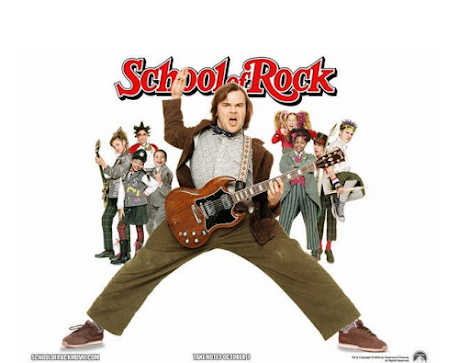
SCHOOL OF ROCK


Characters in - School Of Rock

  • Describe some of the main characters in School of Rock. 

  • Begin by making brief notes to describe the main characters:


Focus Questions may include:

  • Appearance and clothing

  • The kind of people they are

  • Behaviour, actions and opinions

  • Changes in character during the story


  • Student should consider the following characters:

    • Dewey Finn

    • Miss Mullins

    • Zack

    • Summer

    • Lawrence

    • Freddy

    • Tomika


Focus Questions may include:

  • Kind of person

  • Appearance, hairstyle, costume

  • Behaviour and actions

  • Opinions / Quotations

  • At the beginning of the story …

  • At the end of the story …


Describing the Characters

  • Students select one of the main characters in School of Rock.

  • Each student draws the character in the centre of a page.

  • Using their notes, students write sentences that describes the character around their illustration.  This should include an explanation of the role the character played and why the character appealed to them.

  • Beneath the illustration students write a short paragraph to describe the character and evaluate the role the character played in School of Rock.


As a class make a character gallery for School of Rock by combining student illustrations.


Questions:


LOS AÑOS 70: EVOLUCIONES Y FUSIONES.

La potencia de los amplificadores, la distorsión de las guitarras, las melodías diluidas entre gritos y un ritmo marcado y repetitivo son algunas de las características de un nuevo rock que aparece en la década de los setenta: el Rock duro, también llamado heavy metal o heavy rock.

La mayoría de los grupos que tocaron este estilo lo fusionó con otros posteriores. Los más destacados fueron Iron Maiden o ACDC


 La crisis económica de los años 70 propició el nacimiento de la Música punk. Su lema es el no futuro, y se caracteriza por la búsqueda continua del escándalo, como reacción al desencanto social. Su actitud, su ropa, su estética han tenido muchos adeptos, incluso en la sociedad de hoy en día. En su música se observa la inexistencia de la melodía, los gritos continuos, el ruido y el ritmo vertiginoso. Los Sex Pistols y The Clash son sus más claros exponentes. En España destacó Ramoncín.


La reacción a la estética punk no se hizo esperar. El espectáculo, unido a la buena música y a la mezcla del pop y el rock, además de una excelente puesta en escena y una promoción discográfica, produjo la aparición de cantantes y grupos que no tienen un estilo definido, pero que conectan con los gustos de la sociedad del momento. Es la época de los que muchos llaman rock comercial y otros el glam rock.

  Revive los días de Glam Rock. Esto te llevará de nuevo a los días en que los hombres llevaban zapatos de plataforma, pantalones de satén y brillo de labios. Características de las actuaciones de leyendas del rock de la década de 1970 como David Cassidy, Rod Stewart, T.Rex, Bay City Rollers y muchos más.


  LOOK FOR INFORMATION ABOUT THESE ROCK LEGENDS:
CHOOSE 1:

1-THE RAMONES
2- JIMI HENDRIX
3-IGGY POP
4- PETE TOWNSHEND
5-ANGUS YOUNG
6-THE CLASH
7.THE DOORS
8. BLACK SABBATH
9. LED ZEPPELIN

1-When did the band begin?
2-Components of the band
3-Instruments they play
4-Lyrics: what are about
5.Music style.
6-Concerts, tours, L.P.S  ...


Click on the words below:
 
HISTORY OF ROCK


lunes, 8 de febrero de 2021

FOR ELISA-BEETHOVEN

(Idea de Jose Ramón-Musiqueando)


FOR ELISA


The year 2020 is the "BEETHOVEN YEAR". On December 16, the 250th anniversary of the birth of this musician is celebrated, and that is why throughout 2020 there are many events to remember him. "PARA ELISA" is one of her best-known works. You have heard it in some television commercial, mobile tone ... and everyone who starts studying piano dares with it.

But who was Elisa really?
They say that, in 1810, Beethoven attended a piano recital where Teresa, a very talented girl who dazzled the entire audience, was going to perform ... until it was time to perform a Beethoven play, which was present there. Nervous, the poor girl was unable to touch her and left the room crying. Beethoven ran after her and, to calm her, promised to compose a sonata for her. The following day, the pianist received a score that over time has become immortal. It was called "For Teresa (memories of April 27, 1810)". It is supposed to have been a confusion of those who studied Beethoven's manuscript, mistaking "Therese" (which was what he supposedly put) for "Elise". Another version of this story claims that Beethoven dedicated the popular song "In Memory of Elisa", referring to Elisabeth Röckel, a soprano with whom the pianist had a good friendship.


La pieza Para Eliza original:


Aquí tenéis la versión TRAP :


O versión flamenco:


QUESTIONS:

1-Which version do you prefer?
2-What would think Beethoven about this covers of his music?
3-Did you know this song?
4-Do you know somebody around you who can play For Elisa?
5-Imagine a moment in your life, that you would use this song.....in a future moment....or in a present moment...

sábado, 30 de enero de 2021

HUMAN VOICE 2

1. The human voice


How are guitar strings and the human voice similar?  Both rely on vibrations to make sound.

Your Instrument

What is your favorite song? To sing along to your favorite song or just say hello to friends you have to use your voice. But what exactly is a voice and where does it come from?
Just like a guitar or violin uses vibrating, or quickly moving, strings to make music, humans use vibrating body parts to make sounds.

Larynx

Take a deep breath in. You just filled your lungs with air. As you breath out, that air travels back up your windpipe, also called the trachea, the passageway in your throat for air.
At the top of your trachea is a box-shaped area called the larynx. The larynx is nicknamed the voice box because it holds the body parts that help us speak. So you could say the larynx is the source of your voice. 
Have you ever noticed the small bump on the front part of your throat below your chin? That is your larynx.


Vocal Cords

Stretched across the inside of the larynx are two very thin bands of muscle called vocal cords. When we breath in, the vocal cords open to let air pass through the larynx, into the trachea, and down to the lungs.
The vocal folds are open when we breath in and closed when we want to speak.
null
When we breath out and want to talk, the vocal cords close. Air from the lungs trying to pass by the closed vocal cords causes them to vibrate, which makes sound. Hum a little bit of your favorite song and touch your larynx. 
Can you feel the vibrations?


                                          The larynx, or voice box, is located in the throat just above the trachea.

SINUSES BELONG TO RESONATOR SYSTEM:


The human voice consists of sound made by  using the vocal chords for talking, singing, laughing, crying, screaming, etc. Generally speaking, the voice can be subdivided into 3 parts;

1-(Respiratory system) The  breathing, : Lungs, trachea, diaphragm, nose, mouth. 
-The lungs must produce enough airflow to vibrate vocal cords. 

2-(Phonator System) :The vocal chords , the larynx  lips, tongue, teeth. 

-The vocal chords are the vibrators that produce the fine pitch and tone. 

-The articulators( tongue,palate ,cheek ,lips.....)  articulate   the sound. 


3-(Resonator system) :nose, palate, soft palate , chest or rib cage ,facial cavity , cranial cavity.


- The resonators  amplify and intensify the sound


The vocal chords, together with the articulators and the resonators, are capable of producing a lot of sounds. 
The tone of voice may be modulated to suggest emotions such as anger, surprise, or happiness. Singers use the human voice as an instrument for creating music.


Vocal Ranges:


 A typical choral arrangement divides women into higher and lower voices and men into higher or lower voices too.

The four main vocal  ranges are:

-Soprano:


 A high female (or young boy's voice)

-Mezzo-soprano:   
An intermediate female  voice.

-Alto or Contralto: 
A low female (or young boy’s) voice.

-Countertenor
 A male voice that is unusually high, light, and agile, even for a tenor.

-Tenor :
 A high (adult) male voice


-Baritone :


A male voice that falls in between tenor and bass.


-Bass :

A low (adult) male


3. Choral music

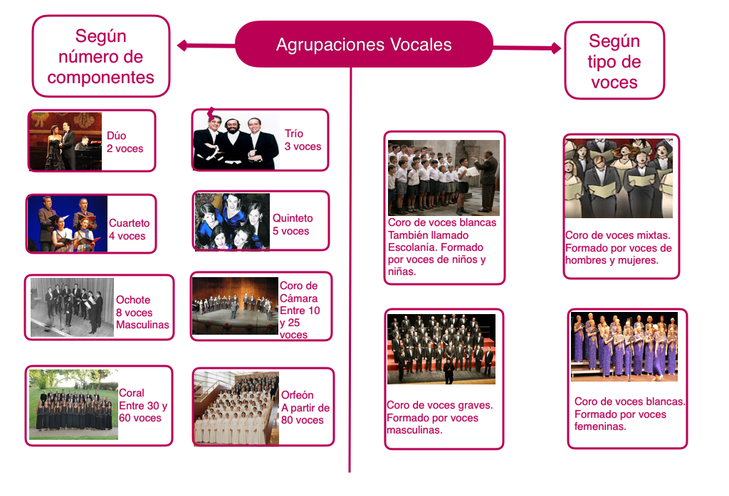
A choir, chorale, or chorus is a musical ensemble of singers. Choral Music, therefore, is the music written specifically for a choir to perform. Choirs are often led by a conductor or choirmaster and can be categorized by the voices:

 Mixed choirs ( with male and female voices). This is perhaps the most common type, usually consisting of soprano, alto, tenor and bass voices, often abbreviated as SATB.

   Male choirs, with the same SATB voicing as mixed choirs, but with boys singing the upper part (often called treble or boy soprano) and men singing alto (in falsetto), also known as countertenor. This format is typical of British cathedral choirs.


   Female choirs, usually consisting of soprano and alto voices, two parts in each.


   Children's choirs, This includes boys’ choirs. 


Exercises:

1-Copy and complete the paragraph using the words below to fill the gaps

When men sing high notes like a soprano it 

is  called---------------------- singing. 

2-Two female singers who are singing a ----------

--------could be either---------------------,

------------------------ or .---------------------------------------

3-Four singers singing in a------------------- are 

probably  S.A.T.B. When there are several 

singers  singing  each part, the group is called 

a .--------------------------

4-When singers make their voices wobble(tambalearse) , it's 

known as------------------------

WORDS :ALTOS, QUARTET, CHOIR, 

TREBLES ,MEZZO-SOPRANO, FALSETTO 

,DUET, SOPRANOS, VIBRATO

2-What type of singer ...

a) has a range that sits between the soprano 

and tenor range?

b) sings the lowest part of all in a choir?

e) has a voice that's lower than a soprano but 

higher than an alto?

3-What do the initials S.A. T.B. stand for?

4-What are the highest boys' voices called

 before their voice breaks?

5-Write out these voice types in order, from