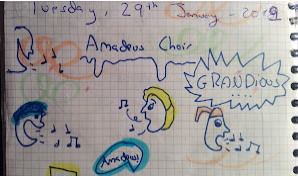
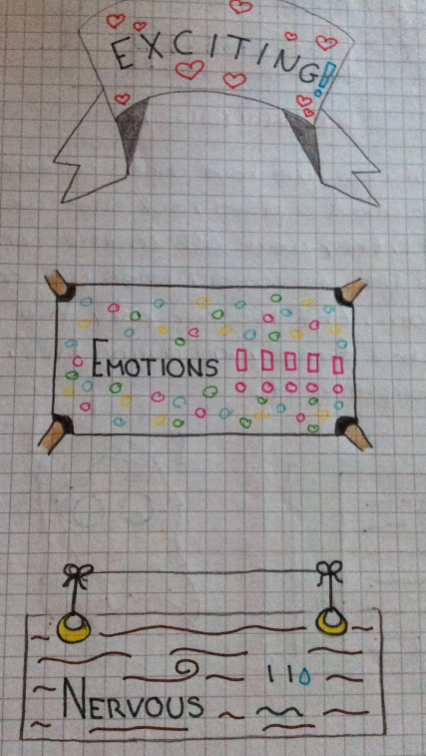
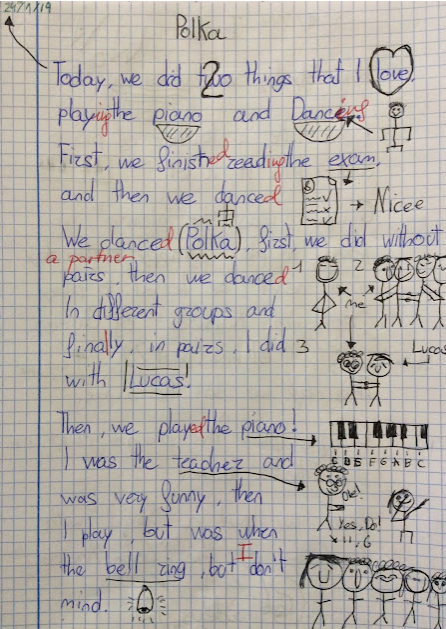
( I can take notes during the lesson. Visual thinking is very useful)
2. 1. ( New vocabulary): Music terminology or another useful words
I learnt some new words: This lesson dealt with... ( + gerund) This lesson was about...
2.2. Activities:
You can use connectors: At the beginning... At first...
Then... Secondly... After the first activity... After this.. Later...
Finally... Eventually...
( If we listened, danced or played a song or a piece of music or a song,I must write the name of the piece of music or the name of the song)
The teacher ( or the teacher´s name) played a video about...(Ex: Mª José puso un vídeo de...) The video was about...( El vídeo era de...)
The teacher ( or some of my partners) collected..., handed out..., played, taught..., danced..., sang..., explained..., reviewed, went over ( "repasó")...
The song dealt with... (+ gerund)
The activity consisted of...( + gerund)
We (or I) played... We ( or I) sang.. We (or I) danced...
We (or I) composed... We (or I ) read..
We ( or I) heard... We ( or I) listened to..
We ( or I) wrote...
We ( or I) drew...
We ( or I) performed... We ( or I) rehearsed...
We ( or I) presented... We ( or I) spoke about... I understood... We went over... We reviewed...
2.3. Lyrics of the song we sang.
3. Emotions and Learnings: I liked...( + gerund) I didn´t like...( + gerund)
The most significant ( or interesting) activity for me today was ...( + gerund) I learnt how to...( infinitive)
What was the most dificult content or activity for me? I needed help from... I helped...to learn...
What am I worried about?
What´s bothering me? Have you got any further suggestions?
(It´s possible you can have questions or doubts related to the topic we dealt with. Try to write these questions so that we can discuss them next day.)
4- Can you draw a picture corresponding to the lesson? ( Stick figures are very expressive too).
In the newcast the words are missing , there is only music ...do we transcribe the news?
In pairs:
As you can imagine this newscast is special because it only has music, text and images will have to be created by you.
Como podéis suponer, este boletín de noticias es especial porque solo tiene música, el texto y las imágenes las tendréis que crear vosotr@s .Todo ello siguiendo lo que sugiere y describe la música.
La actividad cuenta con dos partes diferenciadas, una primera partede invención de noticias e imágenes relacionadas con ellas : 3 sucesos, 2 noticias culturales, 2 noticias deportivas, 1 noticia de última hora, el tiempo para el fin de semana y una segunda partedonde leer las noticias con la música de fondo.
The activity has 2 parts: 1-invention of news and images related to them : 3 events, 2 cultural news, 2 sports news, 1 breaking news, the weather for the weekend and 2- you have to read the news with the music
Después de inventar las noticias las pondremos en común y escribiréis los titulares .
Music suggets much about the society in which it is created. Music reflects a culture.It expresses experience and also affects experience creating feelings and responses in the listener. Music mirrors society , sometines raises questions about society's norms and values, and sometimes has the power to bring about change.
When this happens, music can serve a purpose that it was not intended for.For example, popular music has been known to create an identify for groups of people.Songs that were popular during World War II helped unify soldiers- for example The Moldau by Smetana was used as a resistance song during the Nazi occupation.
1-Why groups of people tend to be identified with certain types of music?( heavy metal, punk, rock, hip hop,rap, alternative music etc?
2-Does this kind of identification steretype students? If so, what are the stereotypes associated with specific music genres?
Os presento tres actividades para analizar la música de 4 anuncios publicitarios, las planteo tanto para comenzar el tema de la música y la publicidad . Estamos acostumbrados a ver y escuchar la música de los anuncios en radio y televisión, ahora vamos a tratar de ver el objetivo de la música en la publicidad a través del análisis.
Here you have 4 activities to analyze the music of 4 commercials.We are used to seeing and listening to the music of advertisements on radio and television, now we will try to see the purpose of music in advertising through analysis.
1-Ikea:
2-CHIQUILÍN
3-FILIPINOS
4-NAVIDUL
Listen to the music with attention and answer the questions:
1-Complete the details of the commercial:
Product being advertised
Product brand
Slogan
Reason of the ad
Target audience
Ad plot
2-What kind of music have they choosen?
Describe the music : vocal, instrumental, mix,instruments you can distinguish, the rhythm, the style.
Investigate who is the composer and the name of the music.
3-Explain the emotions, feelings that the music wants to transmit with the scenes.
4-What function or functions has this music in this commercial? memorize the brand, reinforce the message, gett attention or target the ad to an audience
5-In your opinion,do you think that the music for the ad is right? Would you play other music?
Students listen to some famous songs. You have carry out some activities in order to become familiar with their lyrics and tunes.
Then you will choose your favourite song and dedicate it to a friend, a relative or a loved one explaining the reasons for your choice.
General aim:
-To understand that Music is a way of expressing different cultures and part of Art and such also an expression of human creativity and genius.
Procedure:
Step1: Students listen to the songs one by one .
Step 2: Carry out the activities proposed, in order to become aware of how lyrics and tunes go together in a song: the importance and repetition of some words, its rhythm and structure, the different meanings and purposes a song may have, the instruments in the song etc. so that later you can create your own verses.
Step 3: Finally you have to choose a song and dedicate it to a loved person. You can do it in a audio format, or video format recording yourself dedicating the song and the song itself, using mp3 devices. or mp4 .
Songs: 6 SONGS
1-We are the champions (QUEEN):
a- Listen to the song : circle the correct form and match the expressions to their meanings.
b: Structure: Parts of the song.Instruments you can hear.
c: Sing the song .
d:You have already listened to the song several times. Now that it has become familiar, create your own verses. They will be additional lines to fit into the song's rhythm and structure.
e-Which is the message of the song? How the lyrics and the music help to express the message?
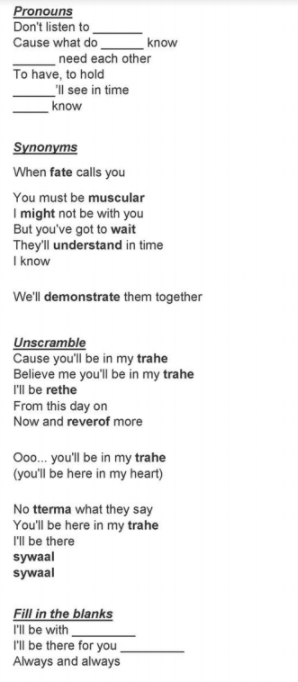
2-YOU'LL BE IN MY HEART(THEME FROM TARZAN BY PHILL COLLINS)
3-IMAGINE-LENNON
a- Listen to the song and make the activities in the sheet.
-b: Structure: Parts of the song.Instruments you can hear.
c: Sing the song .
d:You have already listened to the song several times. Now that it has become familiar, create your own verses. They will be additional lines to fit into the song's rhythm and structure.
e- What kind of world did John Lennon imagine? Read the lyrics and write about his views on religion, war, property and poverty. Make examples. What is the effect of repeated words throughout the song such as no,nothing and not?
4-MESSAGE IN A BOTTLE BY POLICE
a- Listen to the song and make the activities in the sheet.
-b: Structure: Parts of the song. Instruments you can hear.
c: Sing the song .
d. Where are the 3 musicians in the video ?
e. How does the singer feel?
f. Does he keep hoping?Why?
g. Do you think that the island is a metaphore for his sentimental loneliness? Why?
5-TEARS IN HEAVEN BY
ERIC CLAPTON
Tears in HEAVEN, is a ballad by Eric Clapton about the pain Clapton felt following the death of his four-year- old son, Conor, who fell from a window of the 53rd-floor New York apartment of his mother's friend on March 20, 1991.
a- Listen to the song and make the activities in the sheet.
-b: Structure: Parts of the song. Instruments you can hear.
c: Sing the song .
d.Why did Eric Clapton compose this song?
e.Whom is it dedicated?
f.What do you feel ?
You can use this adjetives: angry, emotional, depressed, grateful, unhappy, relaxed, thoughtful, inspired, broken-hearted.
6-ENGLISHMAN IN NEW YORK
a-Listen to the song and fill in the blanks spaces.
b-Structure: Parts of the song. Instruments you can hear.
c-What does the title of the song suggest?
d-Which of these 2 saying do you agree more with and why?
1-"BE YOURSELF NO MATTER WHAT THEY SAY"
2-"WHEN IN ROME, DO AS ROMANS DO"
e-According to the song, if you were " a basque person in New York, what would be your greatest challenge?
We are going to begin a music project focusing on a fantastic
musical film called WEST SIDE STORY.
Today we are going to listen to a piece of music by a composer
called Leonard Bernstein.
The music is from this musical which tells a well-known story.
1- Listen to Mambo (or watch the orchestra performance film) and afterwards have a discussion about what have you litened and seen.
a Did you seen the film?
b What was your favourite part?
c What might the music be describing?
d Did you know the song?
3. The music is called ‘Mambo’ and is from a musical version of Romeo and Juliet.
Do you know Shakespeare’s story? that this version takes
place in New York in the 1950s with Romeo and Juliet now called
Tony and Maria. The Montagues and Capulets are now the Jets and
the Sharks, rival gangs.
4. Listening task :
As you listen again, ask draw the section of the story it might be describing.
I give you three options to choose from. Does it describe:
a. Tony and Maria falling in love?
b. The Jets and the Sharks fighting?
c. Everyone dancing at a party?
5-In the film in this scene all of those things are hapening.
There is no ‘correct’ answer for this, it actually describes all three things. In the original show , the Mambo happens during a dance. Everyone is dancing but the two gangs are pitted against one another. At the end Tony and Maria meet for the first time.
7. FINALLY,
By now, you should at least be able to shout MAMBO at the right time.
If you practice, you can get this hand clap: You need somebody to do it.... It is not difficult but you have to be coordinated and concentrated....practice and practice.
They are AWESOME¡
Es una actividad que consiste en escuchar 5 fragmentos diferentes de 5 obras musicales clásicas. Se trabajará el aspecto emocional de la música (lo que sugiere) y el aspecto cognitivo (instrumentos, voces y otros aspectos musicales..) siguiendo los puntos que veis a continuación:
It is an activity that consists of listening to 5 different fragments of 5 classical musical works. The emotional aspect of the music (what it suggests) and the cognitive aspect (instruments, voices and other musical aspects ...) will be worked on following the points you see below: MUSIC
Jonathan Okseniuk, who is now ten years old, gave this spectacular show of conducting the fourth movement of Beethoven’s Symphony No.5 when he was just three years old. We are still in slight disbelief at the toddler's ability to deliver clear actions, fluid movement and animated facial expressions for the orchestra .
At the age of four, Jonathan conducted the full Chandler Symphony orchestra, and the year after that, he conducted the fourth movement of Mozart’s Eine Kleine Nachtmusik, on a TV talk show. Jonathan is officially a musical prodigy.
Nowadays he plays violin.
Jonathan Okseniuk, accompanied by Qingqing Ye, performs the Mozart Violin Concerto No. 3 in G major,
Marcin Patrzalek:
known mononymously as Marcin, is a Polish percussive fingerstyle guitarist, composer and producer. He is known for combining fingerstyle, ...
3-Listen to the song and focus on the structure (parts) and the instruments.
4-Sing the song
5-Listen and watch the video.
Del galardonado documental, Playing For Change: Peace Through Music, llega "Stand By Me", el primero de muchos Songs Around The World producido por Playing For Change.
Este clásico de Ben E. King presenta a músicos de todo el mundo grabados por el equipo Playing For Change durante sus viajes. Esta canción continúa recordándonos que la música tiene el poder de romper fronteras y superar las distancias entre las personas.
1-Identify the countries that appear in the video(there are at least 10)
2-How many musical instruments are played in the video? Make a list of them.
3-There's an old man singing and playing the harmonics.Can you describe him?What's is his name?
4-What is the topic of the lyrics?
5-Explain the title of the video.
6-Write the synonyms of the following words:
-Dark
-Afraid
-Stand by
-Look upon
Founded in 2007, Playing For Change Foundation was established to create positive change through music and arts education.
They teach music to the children in areas that are rich in cultural traditions but limited in economic resourcers all over the world. They do not have to pay .
Students in PFCF programs report increased confidence, better learning in math, reading, and a belief in a positive future.
WHY MUSIC?
Science has shown that learning music benefits people on many different levels. From enhancing cognitive capacities for children, teens and adults to helping memory, literacy, creativity, self confidence and collaboration skills, the power of music has already been demonstrated by hundreds of scientific studies.
At Playing For Change Foundation, believe the world would be a better place with more music in it. That's why they employ musicians and music teachers around the world to teach music, using it as a tool for education, inspiration and social change.
Dr. Laurel Trainor, Prof. of Psychology, Neuroscience, and Behavior at McMaster University says :
"Young children who take music lessons show different brain development and improved memory over the course of a year, compared to children who do not."